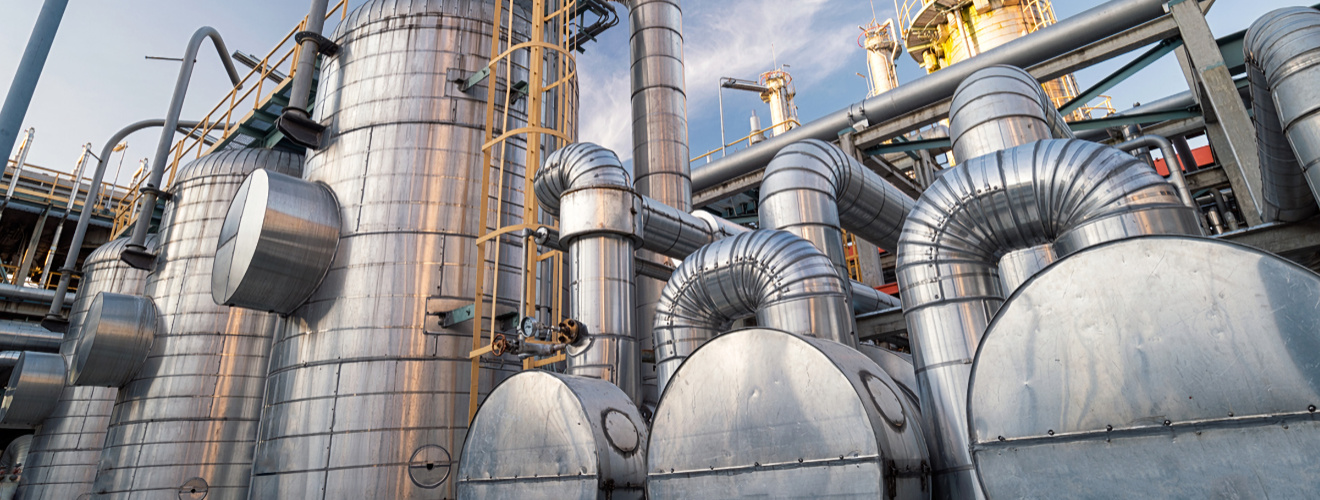
Crude oil enters the distillation unit to establish key product cuts, while heavier vacuum fractions are routed to secondary units to improve yields and margins.
In the refining process the first step is crude oil, or atmospheric, distillation, separating the crude oil in several fractions based on their difference in boiling point. Inside the distillation column there is a set of so called trays with perforations in them to allow for valves or bubble caps. The perforations allow for the vapours to rise through the column.
The liquid/vapour charge allows the heavier, liquid, part to run down the column as a residue. In addition, to provide a better separation of the hydrocarbon fractions the column is equipped with a so called reflux (on top) and a reboiling system (at the bottom).
In order to avoid high temperature cracking of the hydrocarbons the residue will be further distilled in a vacuum (low pressure) distillation column. The vacuum will allow heavier molecules to boil at lower temperatures in order to distil off vacuum gas oil fractions to be fed to a cracking unit.